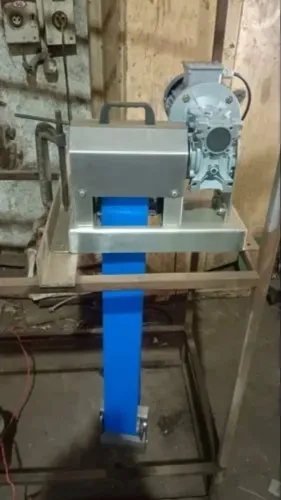

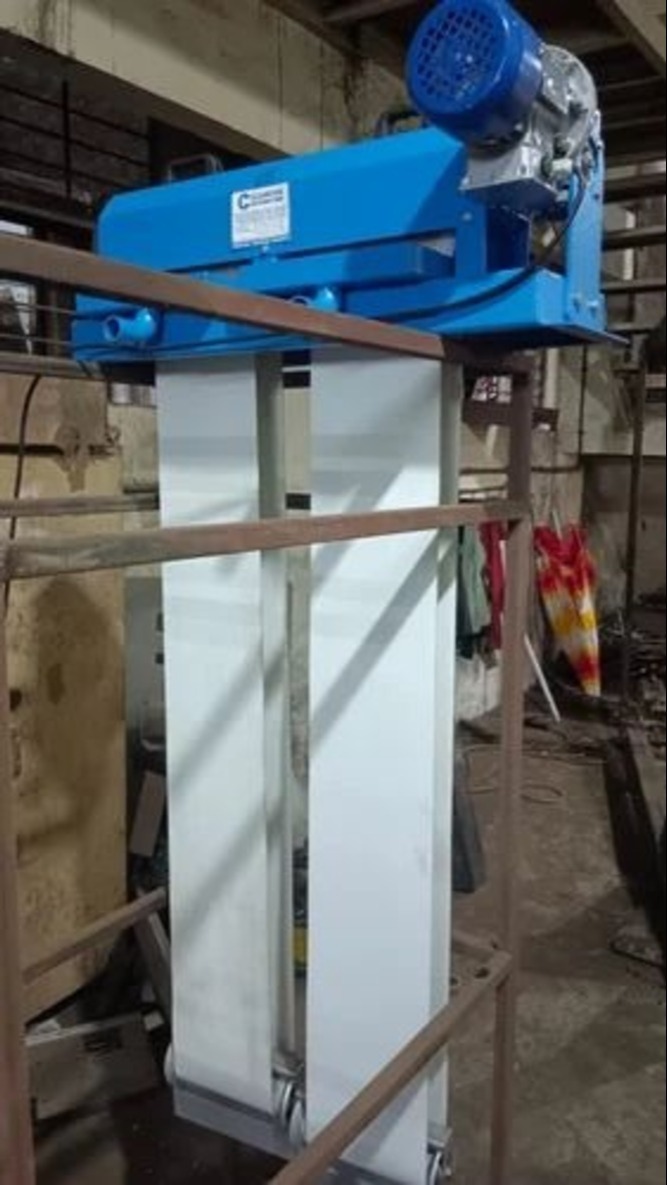
A Vertical Belt Oil Skimmer uses an oleophilic moving belt to collect floating oil from the surface of a liquid. The belt continuously travels through the contaminated fluid, attracts oil to its surface and carries the collected material upward, where a wiping mechanism removes it for collection.
The principle makes belt skimmers useful for tanks where oil regularly accumulates on water, coolant or compatible process fluids.
Understanding the operating cycle helps explain their industrial usefulness.
First, part of the belt enters the contaminated liquid. As it moves through the surface layer, oil adheres to the belt. The moving belt then carries this material out of the tank. Wipers positioned near the upper section scrape the recovered oil from both sides of the belt and direct it toward a collection outlet.
This continuous movement allows floating contamination to be removed without manually scooping oil from the tank.
Vertical belt designs can be particularly useful where floor space around a tank is limited. The mechanism is arranged primarily above the liquid, while the belt extends downward into the tank. This can suit machine-tool reservoirs, industrial washing tanks, sumps and other installations with restricted access.
Before selecting a vertical belt system, however, several factors should be reviewed.
Belt reach: The belt must reach the operating liquid level while accommodating normal fluctuations.
Oil characteristics: Viscosity and temperature affect how readily oil adheres to and releases from the belt.
Tank access: Internal partitions, covers, pipework and machine structures can restrict belt movement.
Contaminants: Chips, sludge and floating solids may interfere with some installations if they accumulate around the belt.
Operating schedule: The expected contamination rate influences how long and how frequently the unit needs to operate.
Manufacturing plants in Pune, Chakan, Bhosari and other Maharashtra industrial clusters often operate CNC machines, machining centres and component-cleaning processes where tramp oil can enter circulating fluids. Belt skimming can be considered when the oil reliably separates and rises to the surface.
The placement of the skimmer is equally important. Oil does not always distribute evenly across a tank. Fluid circulation, pumps, return lines and tank geometry can cause it to gather in particular areas. Positioning the belt near a natural accumulation zone can improve collection.
Operators should also monitor the amount of primary fluid being removed with the oil. The purpose of skimming is selective separation, so excessive coolant or water carryover can reduce operating efficiency.
Routine maintenance generally includes checking the belt condition, cleaning the wipers, inspecting drive components and ensuring that the recovered-oil discharge remains clear.
Cleanosk Automation works with industrial fluid-management and cleaning applications in Pune, where equipment needs to match real production conditions rather than theoretical tank specifications alone.
A vertical belt oil skimmer is a relatively simple mechanical concept, but successful use depends on proper application assessment. Tank geometry, contamination type, fluid level, installation space and maintenance access should all be considered before deciding whether a belt-based system is the appropriate solution.