
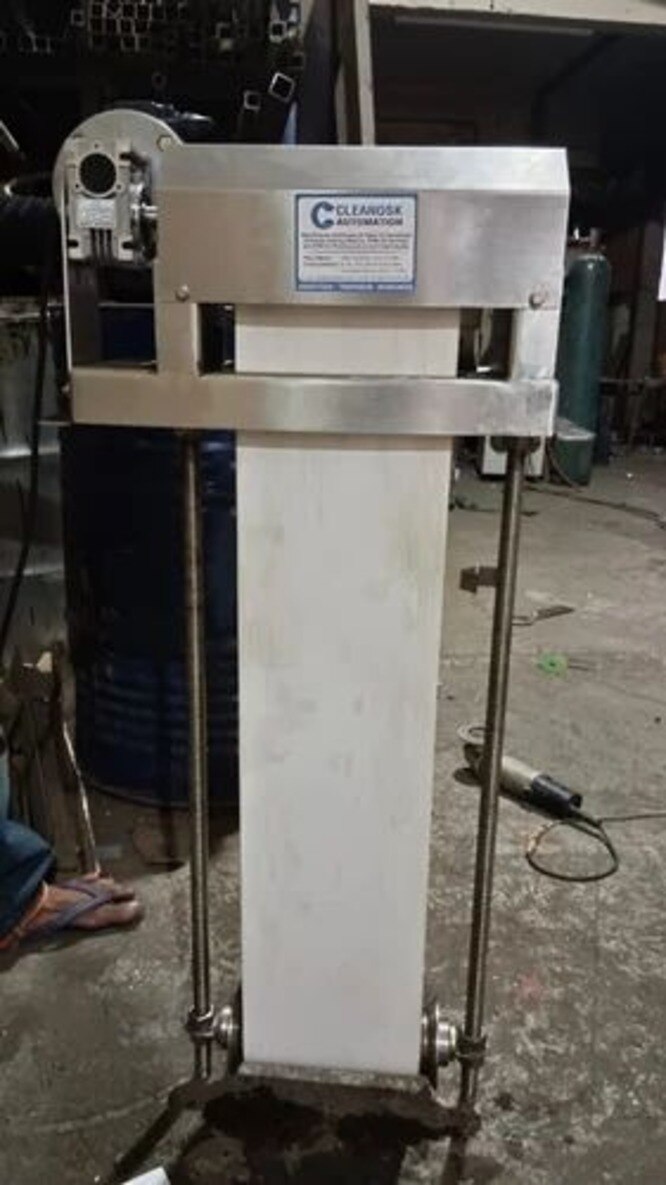
Two belts do not automatically mean twice the oil-removal performance: the result depends on free-oil load, tank geometry, belt immersion, scraper design, and fluid chemistry. By the end, you will know how a double-belt skimmer works, when it suits a coolant or washing system, which figures to request, and when another skimmer design is the better choice.
Key takeaways
- Use two belts when tank width or oil loading exceeds a single belt’s practical capacity.
- Specify belt immersion, oil recovery rate, tank dimensions, materials, and drive details.
- Install at the calmest tank zone where free oil reaches the belt surface.
- Compare suppliers on test data, maintenance access, spares, and commissioning support.
What a double-belt oil skimmer does inside a tank
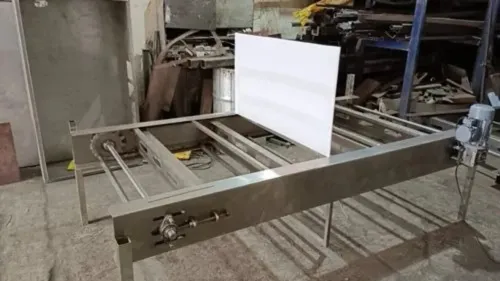
A double belt oil skimmer uses two oleophilic belts to remove free-floating oil from a tank. The belts run partly below the liquid surface, where their surfaces attract the oil film while resisting water or coolant.
As each belt rises, it carries the collected oil above the tank; fixed scrapers or wipers then strip the oil into a separate receiver.
The operating sequence is simple:
- Floating oil moves toward the skimming zone through tank circulation or surface flow.
- Two parallel belts enter the liquid and expose oil-attracting surfaces to the contaminated layer.
- The belts rotate upward, lifting oil out of the tank while most of the process fluid drains back.
- Scrapers contact each belt above the liquid and direct recovered oil through a chute or outlet into the receiver.
That is the working principle behind industrial double belt oil removal. Two belts increase the available oil-contacting surface and collection capacity when a sump has a continuous tramp-oil load or a single belt lacks sufficient residence time.
They do not solve stagnant corners or poor tank circulation; oil that never reaches the belts remains in the tank.
This design targets free-floating hydraulic oil, cutting oil, grease, or scum. It does not remove emulsified or dissolved oil, and sludge or large chips can block belts, scrapers, and outlets. Specify whether the belts share one drive or use independent drives, along with belt width, immersion depth, scraper position, and the receiver connection.
Why use two belts instead of one?
A second belt earns its cost when the sump receives a continuous tramp-oil load, or when one belt cannot provide enough oil-contact area and residence time before the fluid leaves the tank. Two belts can collect more free-floating oil without forcing one belt to run faster.
Double belts do not remove emulsified or dissolved oil. If the coolant looks uniformly milky and shows no separate surface layer, adding another belt will not solve the problem; consider process changes, coalescing, centrifugation, ultrafiltration, or chemical treatment.
| Single belt | Double belt |
|---|---|
| Lower purchase cost, power demand, and number of wear parts | Higher collection coverage and nominal recovery capacity |
| Suitable for one collection zone and a moderate oil load | Useful when oil reaches two zones or one belt cannot keep up |
| Simpler alignment, scraping, and cleaning | More belts, scrapers, bearings, drives, and adjustment points to maintain |
A second belt adds little value in a small, shallow tank. It consumes usable area, needs extra clearance, and can obstruct chip removal or access for cleaning. Two drives also increase electrical consumption; a shared drive reduces equipment count but removes independent speed control.
Before buying a double belt oil skimmer in Pune, request a drawing that identifies belt width, immersion depth, spacing, scraper layout, and drive arrangement. Independent belt tension adjustment helps correct unequal loading, while accessible cleaning points limit downtime from chips, sludge, fouling, and scraper wear.
Ask for overflow protection on each oil receiver; a full container can stop collection even when both belts are working.
Which fluids, tanks, and installation positions suit the design?
A double-belt skimmer will work when free oil reaches a calm belt zone and the fluid level keeps both belts immersed within their usable range. It will not remove emulsified or dissolved oil, sludge, or solids that never separate at the surface.
Treat industrial double belt oil removal as a fluid-management problem, not simply a belt-width decision.
Check these conditions before choosing the machine:
- Confirm the oil type: hydraulic oil, cutting oil, tramp oil, grease, or surface scum can be collected; stable coolant emulsions need treatment or separation first.
- Trace flow through the tank. Pumps, washer spray returns, aeration, chip baskets, and dead corners can carry oil away from the belts or create turbulence that washes oil back into the fluid.
- Measure minimum and maximum liquid levels, available mounting clearance, tank depth, and access for removing both belts and scrapers.
- Specify a calm compartment or circulation path for a large, divided, or turbulent tank. More belt width will not fix oil that cannot reach the skimming zone.
- Set belt immersion from actual fluid behaviour. Too little reduces pickup; too much increases coolant carryover, belt drag, and motor load.
| Application | Suitable position | Check before installation |
|---|---|---|
| Coolant tank | Return corner or calm side chamber | Free tramp oil, stable level, low surface turbulence |
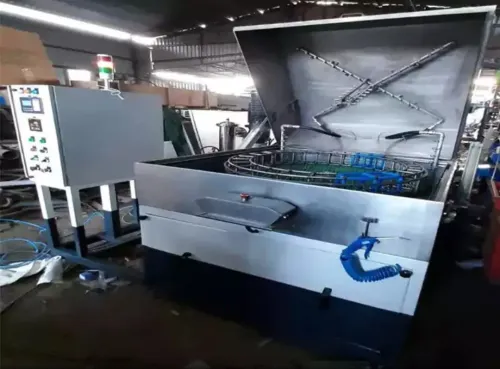
| Washer | Downstream settling chamber | Spray return flow, detergent, filtration, and cycle timing |
| Sump | Near the oil-rich surface zone | Continuous oil load and clearance around both assemblies |
| Settling tank | Outlet-side surface zone | Adequate residence time and separated oil layer |
| ETP | Equalisation or oil-separation stage | Confirm oil is free, not emulsified, and define solids handling |
Which performance figures and construction details must you specify?
Specify recovered-oil output in L/h or mL/h, not belt width alone. Require the figure at a stated oil viscosity, temperature, free-oil layer thickness, bath volume, belt immersion depth, fluid chemistry, and tank flow rate. Ask for water or coolant carryover in the recovered oil, with the test method and acceptance percentage.
| Requirement | Specify | Why it matters |
|---|---|---|
| Operating limits | Oil viscosity, fluid temperature, maximum solids, tank depth, immersion range, and continuous running time | Prevents poor pickup, belt damage, or motor overload |
| Construction | Stainless steel, polyurethane, or PVC belt; scraper material; wetted-part compatibility with alkaline cleaners, additives, solvents, and abrasive fines | A belt suited to coolant can swell, harden, or lose oil affinity in a washer |
| Arrangement | Belt width, spacing, immersion depth, scraper layout, receiver position, and whether each belt has an independent drive | “Double belt” does not describe one standard layout |
| Safety | Belt and scraper guards, emergency stop, overload protection, earthing, washdown-appropriate ingress protection, and ISO 12100 risk assessment | Exposed moving parts and water ingress create preventable hazards |
Require drawings, motor rating, replacement-belt part numbers, scraper adjustment instructions, cleaning intervals, lubrication points, and the time needed to remove each belt. Ask Cleanosk Automation for these figures under a sample of your actual fluid, not clean water.
Also specify whether the recovered oil is for disposal, recycling, or reuse. A high removal rate is not useful if it carries away excessive process fluid.
Related product
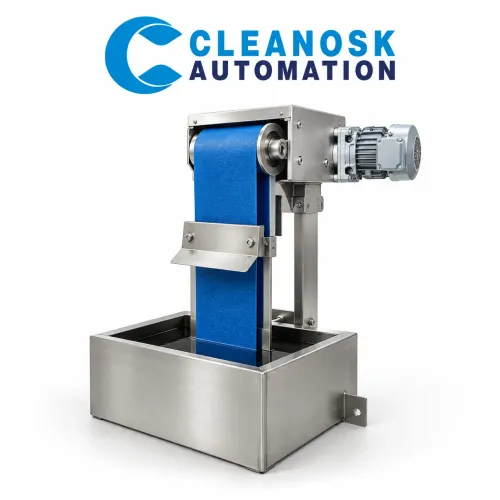
 | Oil Skimmers Cleanosk Automation is a leading manufacturer, supplier, and exporter of Double Belt Type Oil Skimmers in India. View product → |
How should a Pune buyer compare suppliers and alternative skimmer designs?
Treat “oil skimmers manufacturer double belt skimmer for explained in pune” as a search phrase, not proof of suitability. Compare suppliers using your actual oil type, temperature, tank dimensions, immersion depth, solids load, recovery rate, and acceptable water carryover. Check Pune availability of belts, scrapers, motors, gearboxes, and service separately.
| Option | Main strength | Choose it when |
|---|---|---|
| Single-belt | Lower cost, power, and maintenance | One pickup zone handles the oil load |
| Double-belt | More contact area and nominal capacity | A wide tank or heavy free-oil load justifies two assemblies |
| Vertical-belt | Compact access and deeper pickup | Headroom and tank geometry suit a vertical installation |
| Tube | Simple, low-drag pickup | Light surface oil exists in a narrow or shallow tank |
| Disc | Broad surface contact | The fluid is calm and the oil film is consistent |
| Horizontal scraper | Surface skimming without deep immersion | Oil and scum collect at a controlled surface point |
Do not compare “double belt” as a standard category: one double belt skimmer manufacturer may supply two parallel belts, while another supplies independently driven assemblies. Request a drawing showing belt width, arrangement, scraper position, immersion depth, and drive layout.
For a double belt oil skimmer in Pune, require a test using your fluid and contamination load. Measure free-oil removal and recovered-oil water or coolant percentage separately. Reject a supplier that promises removal of stable emulsions without proposing coalescing, centrifugation, filtration, or chemical treatment. Ask how scraper wear, belt drag, and replacement-part response are handled.
Frequently asked questions
What is a double-belt oil skimmer?
It is a tank-mounted oil-removal device with two oleophilic belts that dip below the liquid surface, collect floating oil, and discharge it into a recovery container.
Why use two belts instead of one?
Two belts provide more collection surface and can suit wider tanks, higher free-oil loading, or layouts where one belt cannot cover the required skimming area.
Which fluids and tanks suit a double-belt skimmer?
The design suits tanks containing free-floating tramp oil, hydraulic oil, or lubricating oil on water-based coolant, wash water, or process fluids. It does not remove dissolved oil or stable emulsions.
What should you specify when buying an industrial double-belt oil skimmer?
Provide the fluid type, tank length and width, liquid depth, oil thickness, required recovery rate, belt immersion, belt material, scraper design, motor details, and available installation position.