
A rotary machine cleans only the surfaces its fluid, spray, chemistry and drying process can reach. By examining part geometry, soil type, loading method and the complete wash cycle, you can decide whether rotation is suitable or whether the part needs directed jets, filtration, brushing, ultrasonic action or another process.
Key takeaways
- Rotation improves fluid access, drainage and exposure between part faces.
- Specify chemistry, temperature, spray pressure, contact time and basket loading together.
- Use secondary operations for blind holes, heavy soils and delicate surfaces.
- Validate cleanliness with defined residue limits and repeatable inspection tests.
What the rotary mechanism reaches—and what it leaves behind
A rotary component cleaning machine cleans surfaces that the fluid, spray and air can physically reach. Rotation exposes more of each part, improves drainage and prevents one face from staying hidden, but speed alone cannot overcome weak chemistry, low temperature, short contact time or an overloaded basket.
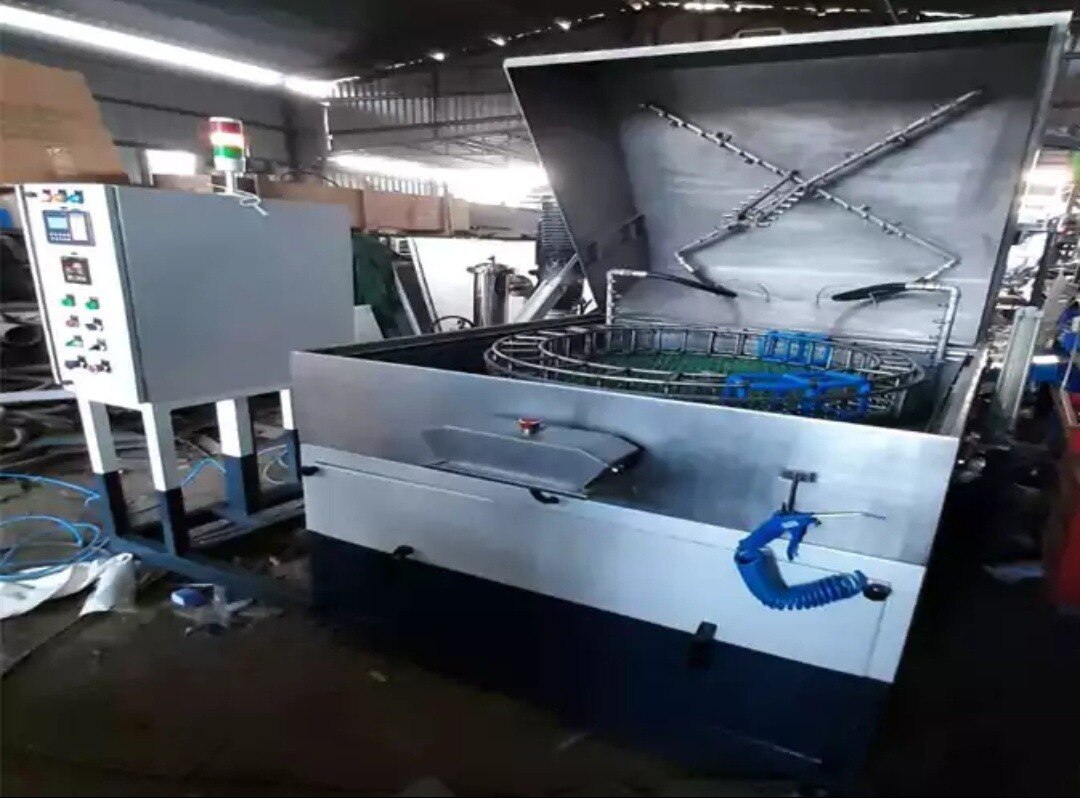
A rotary parts cleaning machine explained for buyers is a handling system, not a guarantee of total cleanliness. A basket or drum tumbles loose parts through fluid, while an indexing table carries fixtures through spray, rinse and dry stations.
Suitable examples include fasteners, turned components, gears, shafts, bushings, castings, brake parts and transmission components when their size, weight, material and allowable contact match the machine.
| Surface or feature | What rotary action reaches | What it can leave behind |
|---|---|---|
| External faces and edges | Direct spray and repeated exposure | Oil films in shielded corners |
| Open bores and recesses | Fluid entry, rotation and drainage | Chips or residue at the far end |
| Threads and undercuts | Exposed areas facing the spray | Contamination in shadowed thread roots |
| Blind or intersecting passages | Only the accessible opening | Trapped oil, chips and rinse water |
| Touching parts in a basket | Outer surfaces after movement | Contact patches between components |
The rotary component cleaning machine uses differ by process step: post-machining removal of coolant, cutting oil and swarf; pre-assembly degreasing; pre-paint preparation; or post-heat-treatment cleaning. Internal cleanliness requires directed jets, flushing, air blow-off or ultrasonic action, plus verification of residual particles and fluid.
Which parts can rotate safely through the cleaning process
A part is suitable when the rotary fixture can hold it securely, expose its surfaces to spray or immersion, and drain it without damage. Check maximum length, width, diameter, weight and centre of gravity against the machine’s fixture limits; an unbalanced load can cause vibration, rubbing or a stalled rotation.
| Part profile | Usually suitable | Conditions to verify |
|---|---|---|
| Small fasteners, bushings and turned parts | High suitability | Prevent nesting; specify basket mesh and maximum batch mass |
| Shafts, gears and brake components | Suitable | Support long parts and protect teeth, journals and machined faces from impact |
| Castings and transmission housings | Conditional | Confirm spray access to pockets, intersecting bores and threaded holes |
| Delicate, thin-wall or coated parts | Conditional | Limit contact, pressure, temperature and chemical exposure |
| Large, heavy or irregular parts | Conditional or unsuitable | Check fixture clearance, balance, lifting method and allowable load |
Geometry decides more than appearance. Open faces, external diameters and through-bores clean readily; blind holes, undercuts and touching surfaces need nozzle orientation, part manipulation or internal jets.
Loading pattern is part of the process, not a basket detail. State the approved orientation, separation, maximum load and drainage position, then test the worst case: dirtiest parts, shortest cycle, minimum bath condition and fullest load.
For rotary component cleaning for machine uses such as post-machining degreasing, plating preparation or pre-assembly washing, confirm material compatibility with the detergent, temperature and rinse water. Aluminium, elastomers, coatings and precision finishes can stain, swell, corrode or lose dimensional control when the chemistry or heat is wrong.
Why automotive production uses rotary cleaning after machining
Machining oil left on a gear can contaminate assembly grease, interfere with coating adhesion, or carry chips into a bearing. Among rotary component cleaning machine uses, post-machining cleaning is common because rotation exposes changing surfaces while sprays remove cutting oil, coolant residue, swarf, abrasive fines and loose chips.
| Production step | Typical contamination | Why rotary cleaning fits |
|---|---|---|
| Post-machining | Cutting oil, coolant, chips and swarf | Spray action reaches exposed faces, edges and bores while rotation improves drainage |
| Stamping or forming | Press lubricant and metal fines | Controlled washing removes residues before assembly or coating |
| Heat treatment | Quench oil, carbonised oil and scale particles | Washing separates loose deposits before inspection or downstream treatment |
| Plating or painting preparation | Handling dirt, rust-preventive oil and polishing compound | Rinsing reduces chemical carryover and improves surface consistency |
| Remanufacturing | Grease, assembly debris and mixed-age soil | A defined cycle restores parts before inspection or reuse |
A rotary component washer for automotive parts is not judged by appearance alone. ISO 16232:2018 provides methods for extracting, filtering and analysing particulate contamination; the required particle limit depends on the component and its function.
Washing loosens and carries away soil, but weak chemistry or a depleted bath leaves an oily film. Rinsing removes detergent, suspended particles and dissolved residue; poor rinsing returns contamination to the part. Drying then prevents water spots, corrosion and trapped moisture before assembly.
Baked-on carbon, oxidised films, paint, scale and polymerised residues need stronger chemistry, longer exposure, brushing, blasting or another pretreatment. Validate the cycle using the dirtiest expected parts, not bright samples.
When rotation is not enough for holes, heavy soils or delicate surfaces
A blind hole can look clean at the entrance while retaining oil, chips or wash water at its closed end. Rotation improves exposure and drainage, but spray remains largely line-of-sight; intersecting passages, deep threads, undercuts and surfaces touching another part need correctly aimed jets, flooding, immersion, part manipulation or ultrasonic action.
Rotation describes handling, not cleaning power. A rotary parts cleaning machine explained only as a turning basket or indexing table tells you little about its process. A rotary component washer for automotive parts may remove fresh cutting oil, coolant, swarf and assembly dirt, but it is not automatically a deburring, ultrasonic or chemical-stripping system.
Add a different or additional method when:
- Baked-on carbon, polymerized oil, paint, scale or heavy abrasive residue remains after normal spray time; use a stronger compatible chemistry, heat, brushing, blasting or a defined pretreatment.
- Rust or corrosion is present; cleaning will not restore damaged metal, and an inhibited wash or separate derusting process may be necessary.
- Adhesive, sealant or cured bonding material is present; choose a solvent or alkaline process that attacks the residue without attacking the substrate.
- Precision, cosmetic or fragile parts could collide, entangle, deform or suffer edge impact; use nests, separators, soft contacts, lower speed or non-tumbling indexing.
- Aluminium, zinc, magnesium, plated surfaces, rubber or engineered plastics face chemical incompatibility; confirm concentration, temperature and exposure limits before production.
Specify controlled drainage and drying as part of cleaning. Air knives, blow-off, vacuum or heated air must clear blind holes and threads, or trapped chemistry can cause corrosion and assembly failure.
How to specify and validate a rotary cleaning process
A credible specification starts with the dirtiest acceptable part, not a showroom sample. Document rotary component cleaning for machine uses such as post-machining chip removal, pre-assembly degreasing, pre-paint preparation, plating preparation, or final inspection; each demands different chemistry, contamination limits and evidence.
1. Ask the component cleaning machine manufacturer for the approved part envelope, maximum weight, fixture or basket capacity, loading pattern and orientation. Require a demonstration at maximum load with nested, pocketed or difficult-to-drain parts.
2. Require a stage-by-stage cycle sheet showing loading, prewash, wash, rinse, recirculation, drain, air blow-off and drying times. State pressure, flow, temperature, chemistry concentration and bath condition for every stage.
3. Request filtration details together: circulation flow, filter rating, nominal or absolute classification, filter area, bypass protection and the test method. A micron rating alone does not prove particle removal when filters load or contamination bypasses them.
4. Convert the cycle claim into good cleaned parts per hour. Include loading, unloading, drain and drying time, then subtract expected rework; indexing cycles per hour are not finished-part throughput.
5. Define final cleanliness before purchase. Specify allowable oil residue, particle size and count, visual standard, moisture limit and sampling location, then demand test reports from the shortest cycle and minimum bath condition.
Validate the result on the worst geometry and dirtiest load. Cleanosk Automation is one supplier to ask for this evidence, rather than accepting a nominal basket capacity or generic “clean” claim.
Related product
 | Rotary Component Cleaning Machines Rotary Component Cleaning Machines Cleanosk Automation is a trusted manufacturer, supplier, and exporter of Rotary Component Cleaning Machines in India. View product → |
Frequently asked questions
What does a rotary component cleaning machine actually clean?
It cleans surfaces reached by the washing fluid, spray and drying air. Rotation exposes more faces and improves drainage, but it cannot clean areas blocked by contact, trapped air or inaccessible geometry.
Which parts can rotate safely through the cleaning process?
Parts need secure loading, sufficient structural strength and surfaces that tolerate the selected chemistry, temperature, spray force and handling. Confirm that edges, threads, thin walls and finished surfaces will not collide or deform.
Why is rotary cleaning used after automotive machining?
Machining leaves chips, cutting fluid, fines and handling residue on components. Rotary movement presents more of each part to the wash and rinse stages, then helps fluid drain before drying and downstream inspection or assembly.
When is rotation not enough for component cleaning?
Rotation alone is insufficient when holes trap chips or fluid, soils need stronger chemical action or delicate surfaces cannot tolerate the required spray force. Add targeted jets, flushing, filtration, brushing, immersion or a separate process when testing shows residue remains.
How do you validate a rotary component cleaning process?
Define the required cleanliness result, then test representative parts at the worst-case basket load. Check visible chips, oil or particulate residue with a documented inspection method, and record chemistry concentration, temperature, spray conditions, cycle time and drying performance.